

Financial reporting software enhances FP&A efficiency by automating manual tasks, consolidating data, and delivering real-time insights for faster decision-making. It replaces spreadsheet-heavy workflows with intelligent automation, reducing errors and freeing finance teams to focus on strategic analysis and planning.
Many FP&A teams still rely on spreadsheets for budgeting, forecasting, and reporting. This leads to repetitive data entry, formula errors, version-control issues, and long report preparation times, slowing down the entire financial planning cycle.
As a result, according to the FP&A Trends Survey, 45% of FP&A teams spend their time on data collection and validation, while only 35% is spent on generating insights that truly drive business performance.
What if your financial reporting software could convert all that manual work into meaningful insights in a fraction of the time?
What FP&A Does and Where the Bottlenecks Are
Financial Planning and Analysis (FP&A) serves as the analytical backbone of every organization, guiding strategic decisions through financial insights and data interpretation. Yet, many FP&A teams remain bogged down by outdated manual processes that limit efficiency and accuracy.
Financial Planning and Analysis (FP&A) teams transform financial data into actionable insight for executives. They handle budgeting, forecasting, variance analysis, and performance reporting, activities that guide business strategy.
As businesses become increasingly data-driven, leaders also recognize the importance of SEO in understanding market demand and customer behavior, allowing financial insights to align more closely with revenue-generating channels.
However, FP&A teams often face process bottlenecks: manual spreadsheets, disconnected data sources, and time-consuming consolidation tasks. These challenges limit agility and make it difficult to deliver timely, accurate insights.
Modern financial reporting software and FP&A software address these pain points by automating workflows, ensuring data consistency, and improving collaboration.
How Financial Reporting Software Eliminates Manual Work
Modern finance teams need tools that optimize daily operations while improving visibility across the business. The right financial reporting software can replace hours of manual data entry with instant, automated insights that drive performance.
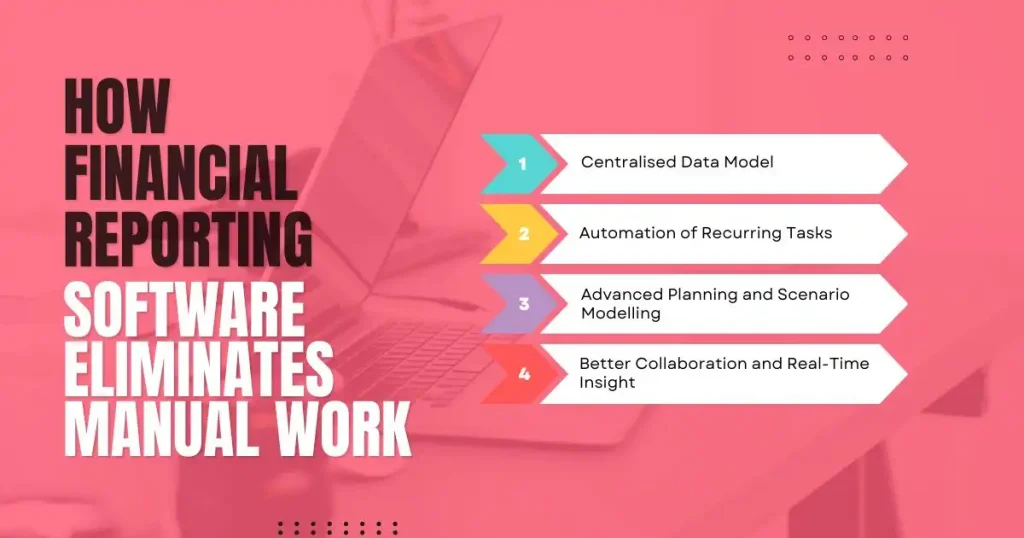
Centralised Data Model
Financial reporting software consolidates data from multiple systems, ERP, CRM, and general ledger, into one unified model. This allows FP&A teams to access consistent, real-time data without manual reconciliation.
Automation of Recurring Tasks
Automated workflows handle repetitive tasks like account reconciliations, monthly closes, and scheduled report updates. By automating these functions, FP&A professionals can focus more on analysis and decision support rather than administrative work.
Advanced Planning and Scenario Modelling
Modern FP&A systems enable flexible modelling and “what-if” scenarios that quickly adapt to business changes. This helps teams assess different outcomes, manage risks, and make faster strategic decisions.
Better Collaboration and Real-Time Insight
Collaborative dashboards and shared workspaces replace static spreadsheets, giving all stakeholders access to real-time metrics. This transparency enhances accountability and speeds up the decision-making process.
Core Capabilities to Look For in Financial Reporting Software
Selecting the right FP&A software starts with understanding the features that truly matter. These capabilities not only improve efficiency but also ensure that your finance team can operate strategically, not just operationally.
Data Connectivity and Governance
A strong FP&A software platform integrates seamlessly with ERP, GL, and other business systems while ensuring strict governance, data quality, and audit trails.
Modelling and Scenario Analysis
Look for dynamic, driver-based models that allow “what-if” forecasting and stress-testing to enhance planning accuracy.
Dashboards and Visualization
Interactive dashboards and visual analytics turn complex financial data into digestible insights for leadership teams.
Automation and Workflow
End-to-end automation of close, reporting, and forecasting cycles saves time and minimizes errors.
Usability and Collaboration
User-friendly interfaces, version control, and multi-user collaboration tools streamline review and approval processes.
Scalability and Future Readiness
As businesses grow, scalable financial reporting software ensures performance, compliance, and multi-entity reporting remain efficient.
Automation in Action: Reporting Use Cases for FP&A
Automation is the bridge between financial data and strategic insight. With advanced FP&A systems, businesses can generate real-time reports and scenario updates that enhance both agility and accuracy.
Automated Management Reporting Packs
FP&A teams can automate the creation and distribution of monthly or quarterly management reports, eliminating repetitive formatting work.
Flash Reporting and Variance Analysis
Real-time dashboards update automatically as actuals come in, allowing instant performance reviews and variance tracking.
Forecast Roll-Forward and Scenario Refresh
Automated roll-forwards update forecasts as soon as new data becomes available, ensuring that plans always reflect current realities.
Single Source of Truth and Auditability
A centralized FP&A system ensures data integrity, enabling consistency across departments and simplifying audits.
Spreadsheet-Native vs. Standalone Platforms: What’s Faster for Your Team?
Every organization must decide whether a lightweight, spreadsheet-friendly tool or a full-scale FP&A suite best meets its needs. Each option has distinct benefits depending on your team’s size, complexity, and goals.
Spreadsheet-Native Platforms
These maintain the familiar spreadsheet interface but layer in automation and integration capabilities—ideal for smaller teams transitioning from Excel.
Full-Scale FP&A Suites
Comprehensive FP&A software suites provide deeper analytics, enterprise-level data consolidation, and global scalability for large organizations.
Choosing What Works Best
- Spreadsheet-native tools deliver faster onboarding and lower cost.
- Full FP&A systems offer advanced analytics, predictive insights, and integrated performance management.
The right choice depends on your data complexity, team maturity, and long-term FP&A goals.
Measurable Efficiency Gains for FP&A
The impact of financial reporting software can be measured in hours saved, accuracy improved, and strategic value gained. Modern FP&A teams that embrace automation consistently outperform those relying on spreadsheets alone.
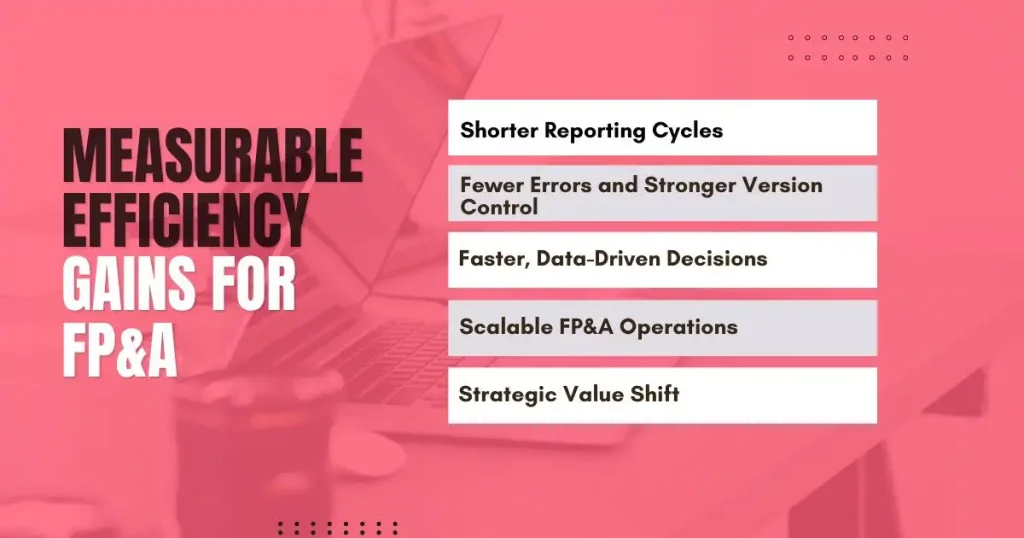
Shorter Reporting Cycles
Automated data updates reduce the time between period close and report distribution, accelerating decision-making.
Fewer Errors and Stronger Version Control
Centralized models minimize formula errors and eliminate conflicting versions of financial reports.
Faster, Data-Driven Decisions
Real-time financial reporting provides instant visibility into performance, enabling proactive strategy adjustments.
Scalable FP&A Operations
A powerful FP&A system grows with the business, managing more users, entities, and datasets without additional manual effort.
Strategic Value Shift
By automating the routine, FP&A professionals can focus on forecasting, insights, and strategic business partnership, enhancing their value within the organization.
Selection Criteria: Choosing Financial Reporting Software for FP&A
Not all financial reporting software is created equal. To achieve real efficiency gains, it’s crucial to select a solution that fits your business model, data structure, and future scalability.
When selecting the right platform, consider the following:
- Integration Fit – Works seamlessly with your ERP, CRM, and existing data environment.
- Governance and Security – Provides role-based access, audit trails, and compliance controls.
- Ease of Use – Minimal learning curve with intuitive interfaces and ready-made templates.
- Scalability – Supports growing data volumes, multi-entity reporting, and global operations.
- Automation Depth – Streamlines workflows for forecasting, consolidation, and variance analysis.
- Vendor Support – Reliable implementation, documentation, and ongoing technical assistance.
Selecting the right FP&A software ensures efficiency gains translate into tangible business performance improvements.
Implementation Playbook to Realise Efficiency Quickly
Even the most advanced financial reporting software requires thoughtful rollout to deliver full value. A structured implementation plan helps finance teams adopt automation effectively and build long-term efficiency.
- Establish a Single Source of Truth
Clean and integrate all financial and operational data across systems to ensure reliability. - Define Reporting Templates and KPIs
Align dashboards, KPIs, and management reports with business priorities. - Automate Repetitive Close and Reporting Tasks
Use built-in automation to refresh data, generate variance reports, and schedule outputs. - Enable Self-Service Dashboards
Empower business units to access financial reporting without IT dependency. - Introduce Scenario-Based Planning
Implement dynamic forecasting and “what-if” analysis to improve agility. - Scale Gradually and Introduce Predictive Features
Add advanced forecasting, AI, and integrated planning once core workflows are stable. - Invest in Change Management and Training
Educate users, refine workflows, and encourage adoption to maximize ROI.
Turning Numbers into Next Moves
It’s time to stop drowning in spreadsheets and start steering the ship. Financial reporting software is not just a tool, it’s your team’s secret weapon to cut through chaos, save hours, and make smarter decisions faster. When data flows in real time, your insights aren’t yesterday’s news, they’re tomorrow’s advantage.
Why settle for patching up Excel errors when you could be predicting growth? The future of FP&A belongs to those who trade formulas for foresight, routine for results. Much like how data-driven strategies power smarter finance decisions, businesses also rely on experts like TPD SEO Philippines to turn raw digital data into measurable growth and long-term visibility.
So, will you keep crunching numbers, or start creating impact?