

Redirects SEO strategy directly affects rankings, crawl efficiency, and domain authority signals. According to Google Search Central, “301 (Moved Permanently) redirects pass PageRank,” meaning link equity transfers to the new URL when implemented correctly.
If authority signals can pass through properly configured redirects, what happens when they are chained, misconfigured, or missing entirely? And how much visibility could your website be quietly losing without a structured redirect SEO strategy?
What Redirects Actually Do in Search Engines
Redirects tell search engines that a page has moved to a new location. They protect user experience and preserve signals when implemented correctly.
Search engines rely on HTTP status codes to understand intent. A proper server redirect communicates permanence or temporary movement. This allows crawlers to transfer relevance and ranking signals.
Here is a simplified breakdown:
| Redirect Type | Status Code | SEO Meaning |
| 301 Redirect | Permanent | Passes most link equity |
| 302 Redirect | Temporary | Signals short-term move |
| 307 Redirect | Temporary | HTTP/1.1 temporary response |
| Meta Refresh | Client-side | Weak SEO signal |
Without redirects, deleted pages create crawl waste. With too many redirects, authority becomes diluted. Redirects seo decisions shape how efficiently search engines interpret structural changes.
Types of Redirects and Their SEO Roles
Understanding the types of redirects prevents accidental ranking loss.
301 Permanent Redirect
A 301 redirect signals that a page has permanently moved. Google treats it as a strong canonical signal. Most link equity transfers to the destination page over time.
This is the preferred seo redirect method during domain migrations, URL restructuring, or HTTPS implementation. It preserves historical signals and prevents authority decay.
302 and 307 Temporary Redirects
Temporary redirects indicate that a page will return. Search engines often keep the original URL indexed. Link equity transfer may not consolidate fully.
Using a temporary redirect during a permanent change creates confusion. This weakens redirect seo impact and can split ranking signals.
Server Redirect vs Client Redirect
A server redirect happens before the page loads. It sends an HTTP response directly to the browser. Search engines interpret this cleanly.
Client-side redirects rely on scripts or meta refresh tags. These are slower and less reliable. From an seo and domain redirect strategy standpoint, server-level rules are stronger and safer.
How Redirects SEO Impact Rankings and Authority Scores
Redirect seo impact becomes visible during migrations and large content updates. Authority scores rely on backlink quality, crawlability, and signal consolidation.
When a high-value page receives backlinks and later returns a 404 error, authority fragments. The referring links remain active but pass no equity.
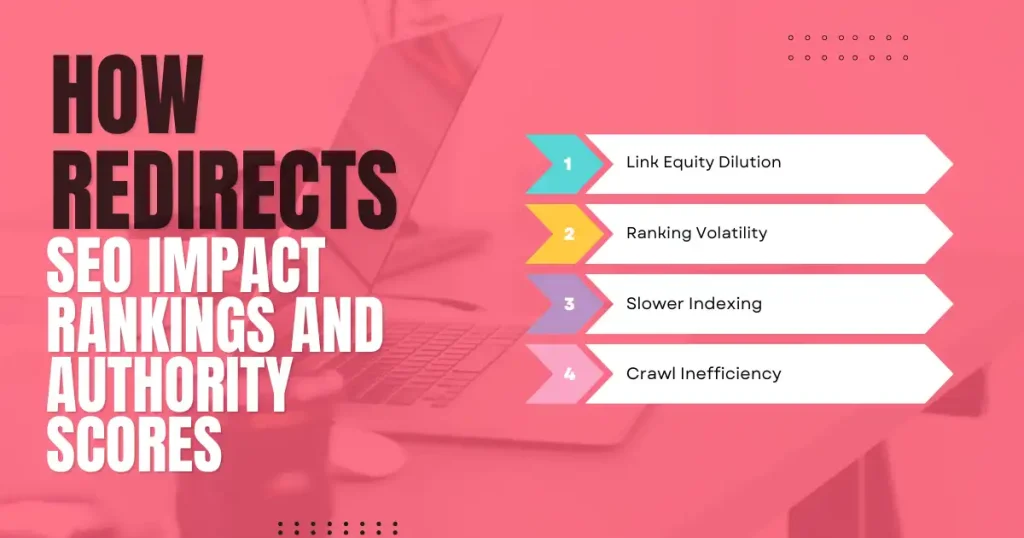
Poor redirect mapping can cause:
- Link equity dilution
- Ranking volatility
- Slower indexing
- Crawl inefficiency
Moz explains that proper redirection prevents drops in visibility when URLs change. This highlights why redirects SEO decisions influence authority metrics in tools like Ahrefs Domain Rating.
Search engines evaluate consistency. If redirect chains exist, equity weakens at every hop. A single 301 performs better than a 301 to 302 chain.
Redirect Chains, Loops, and Authority Drain
Redirect errors quietly reduce performance.
Redirect Chains
A redirect chain occurs when URL A redirects to B, then to C. Each step adds latency. Crawlers must process multiple responses before reaching the final page.
Long chains reduce crawl efficiency. They also risk partial equity transfer. Best practice recommends limiting redirects to one direct hop.
Redirect Loops
A loop happens when URLs redirect back to each other. Crawlers cannot resolve the final destination. Pages become inaccessible.
Loops waste crawl budget and block indexing. They harm redirect seo impact by preventing authority consolidation.
Soft 404 Issues
Soft 404s appear as live pages but provide no meaningful content. If redirects lead to irrelevant destinations, search engines may treat them as soft errors.
This weakens seo redirect best practices and confuses ranking signals.
SEO Redirect Best Practices for Structural Changes
Redirect implementation requires precision.
Below is a practical checklist:
- Map old URLs to relevant new equivalents.
- Use 301 for permanent structural changes.
- Update internal links to reduce reliance on redirects.
- Avoid redirect chains.
- Test server redirect responses using HTTP status tools.
- Monitor Google Search Console for crawl errors.
During domain migrations, a clear SEO and domain redirect strategy ensures continuity. Every legacy URL should point to its closest content match. Redirecting everything to the homepage signals low relevance.
When merging content, redirect retired articles to topically aligned pages. This preserves authority clusters and strengthens semantic relevance.
Server-level configuration through .htaccess, NGINX rules, or hosting dashboards provides stronger control than plugin-based rules. Server redirect setups also reduce load time delays.
Measuring Redirect SEO Impact with Data
Tracking redirects ensures that authority flows correctly.
Key metrics to monitor include:
• Organic traffic trends
• Referring domain counts
• Crawl error reports
• Page indexing status
• Authority score fluctuations
A drop in referring domains after a migration often indicates broken redirects. An increase in 404 reports signals missed mapping.
Use crawl tools to detect chains. Review backlink profiles to confirm that high-value pages redirect correctly.
Redirects SEO management is not a one-time task. It requires auditing after site updates, CMS changes, and content pruning.
Redirect logs also reveal hidden patterns. Large ecommerce sites often accumulate outdated product URLs. Without proper SEO redirect handling, authority disperses across thousands of dead endpoints.
Authority Is Flow, Not a Static Score
Authority behaves like water moving through pipes. Redirects control where that flow goes. When pipes leak, pressure drops. When pipes connect cleanly, flow strengthens.
Think of every backlink as a vote traveling toward your site. A broken path stops the vote. A clean 301 guides it home.
Search engines reward clarity. They favor structures that make sense. Redirects are not just technical rules. They shape trust signals over time.
If you plan a redesign, migration, or content cleanup, treat redirects as strategic assets. Audit before you launch. Test after you publish. At TPD SEO Philippines, we see authority grow when redirect strategy supports long-term visibility.
Protect your flow.